
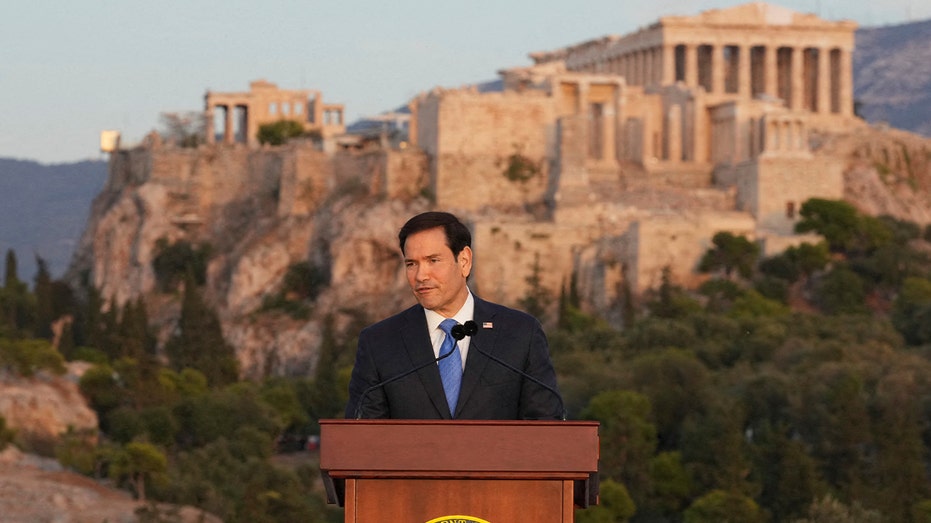
China seeks to replace the United States as the leading global superpower and key to its strategy is securing critical sea lanes. The country that can control the fate of sea lanes will have leverage over markets and the kind of system on which global trade will rely, access to limited natural resources and a significant ability to project power far from its shores. Secretary of State Marco Rubio has been planning and executing on a diplomatic sweep from Panama to Greenland, and now Iceland, to box out China, protect its access and interests and establish an American advantage over the long term.
About 40 years ago, President Ronald Reagan and Soviet leader Mikhail Gorbachev met in Reykjavik, Iceland, and initiated the start of the thaw of Cold War tensions. Rubio returned to the site of the meeting where Reagan refused to surrender his vision of a space-based missile shield to the Soviets and reminded the world that the High North still matters for American power and interests.
Standing side by side with Iceland’s foreign minister, Rubio noted that the location remains a "critical outpost for monitoring clandestine behavior and deterring our adversaries." When a reporter asked him if the United States may expand its military footprint there, he didn’t commit to plans but emphasized that doing so would require Icelandic consent. The negotiations will continue, and, though he didn’t mention Russia or China by name, those are the nations now posing acute threats to the United States and its allies.
TRUMP'S GREENLAND OBSESSION ISN’T RANDOM. HERE’S WHAT’S AT STAKE
The Reykjavik visit follows the recently secured landmark deal with the Kingdom of Denmark. This deal ensures that the United States can prevent the Chinese from establishing its habitual scheme in the Arctic. Critics of the deal have said that the negotiations between Washington and Copenhagen were "much ado about nothing," considering that China isn’t (yet) in Greenland.
This misses the point. As the ice melts, Arctic shipping routes are becoming increasingly navigable, creating new sea lanes (and thus chokepoints) that will shape global shipping and military posturing for decades to come. The agreement gives Washington the authority to block non- NATO commercial and military presence in Greenland, a direct role in screening and accelerating foreign investment in critical sectors, overflight, missile defense access and unrestricted undersea access across Greenland’s territorial waters.
TRUMP DECLARES VICTORY IN HISTORIC DEAL WITH GREENLAND AS HE SECURES 'PERMANENT' US MILITARY RIGHTS
Critically, the deal honors Greenland’s sovereignty, a non-negotiable issue for Denmark, while remaining in force in perpetuity, regardless of if Greenland were to ever become independent. In doing so, the deal clarifies where the 1951 treaty was silent. Dismissing the deal perhaps due to a desire to deny the Trump administration credit also shortchanges the Danes’ very real concessions and diplomatic skill. Furthermore, the deal came just in time for NATO, whose steadfast solidarity is key as Russia ramps up its campaign of terror attacks across the alliance to collapse support for Ukraine.
For years, both the Chinese and Panamanian governments denied China was taking over the Panama Canal . But the president said that the Chinese had illegally stationed soldiers to operate the canal, and a Chinese-owned company was illegally charging for passage to the disadvantage of the United States, which has paid billions to maintain the canal, of which 72% of all vessels (according to the U. S. government) are transiting to or from an American port.
CHINA’S INFLUENCE MACHINE: FEDERAL RECORDS EXPOSE BEIJING’S PUSH TO SWAY AMERICA
For years, the U. S. was asleep at the wheel, allowing China’s incremental, commercial expansion to dominate the canal. After Rubio’s discussions with the Panamanians, a Panamanian court ruled that the contract to operate the container terminals at the canal’s Pacific and Atlantic entrances violated the constitution, and it ended the contract.
Some have praised President Donald Trump’s "Art of the Deal" for these diplomatic successes, that is, making maximalist demands including threats of aggression against trusted allies in the hopes of getting a deal somewhere short of the opening threat, but close to it. But that is the wrong lesson to learn here.
TRUMP’S GREENLAND DEAL SET FOR SIGNING AFTER MONTHS-LONG FIGHT OVER US CONTROL
Trump’sthreats to seize Greenland by force did not help the United States achieve this deal with the Danes, who have been good allies. Instead, it created panic across NATO, which undermined the administration’s efforts to update and strengthen the alliance. Progress toward the deal onlybegan once Trump stopped making threats in response to the blowback.
On Jan. 21, in the lead-up to the Davos World Economic Forum, Trump’s threats contributed to a sharp decline in financial markets. Polling showed 91% of U. S. voters opposed taking Greenland by military force, and Congress was decisively against it, too.
CLICK HERE FOR MORE FOX NEWS OPINION
Asarticulated by Rubio, the Trump administration believes the security of the United States remains linked to Europe’s and that the U. S. must make sure that NATO is strong so that it can continue to be a "deterrent against hostility" which makes "our nations and our continents safer from foreign threats and more secure for our people."
The threats were a distraction; foresight and effective diplomacy are the real story. And, on that front, Rubio won for the president and the country significant gains over the Chinese and the Russians.
CLICK HERE TO READ MORE FROM REBECCAH HEINRICHS