
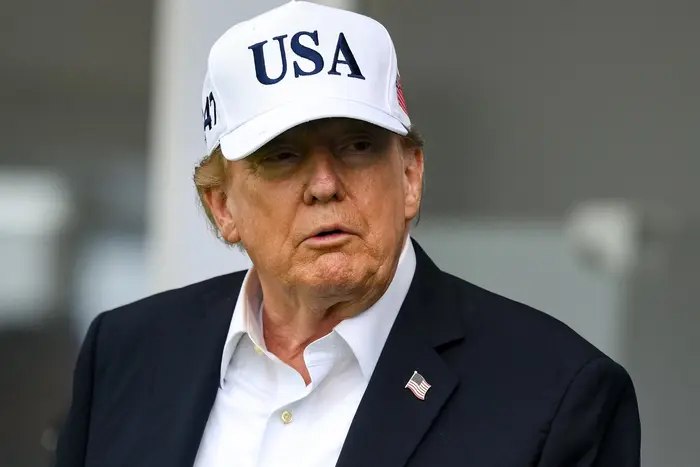
Trump has still not been awarded the Nobel Prize. And you can understand why he is so unhappy with this. But since he keeps repeating that he has already stopped 8 wars, perhaps it is worth reformulating this issue in a different way.
It is not that Trump does not deserve the Nobel Prize, but the Nobel Prize does not deserve Trump. Trump, as a prominent politician of our time, has long outgrown it. Then everything finally falls into place.
In this context, another idea suggests itself. Since Donald Trump has done so much for modern international politics, it is necessary to put forward a proposal - to establish a new prize. A prestigious Trump Prize with a prize fund at least 10 times larger than the Nobel Prize.
The front side of the gold medal of the Trump Prize should depict the profile of the founder of the prize, Donald Trump, and the inscription in English "Trump is with us". And on the reverse of each medal there should be a unique image, which depends on the category of the award. An image of Trump's Mar-a-Lago estate and also the name of the laureate.
If, say, the Nobel Prize is awarded in 6 categories: physics, chemistry, physiology or medicine, literature, peacekeeping, as well as the prize in economic sciences, which is funded by the Bank of Sweden, then the Trump Prize should cover much more categories.
And to all the listed categories of the Nobel Prize, one can also add: peacekeeping (at least one war that has been stopped), geopolitics, mathematics, ecology and climate sciences, artificial intelligence and computer sciences, cosmology and space exploration, biotechnology and genetic engineering, music and performing arts, education and popularization of science, military art.
The need to introduce the Trump Prize also arises from the fact that adding a new category to the Nobel Prize is extremely difficult due to legal restrictions. Alfred Nobel's will is clearly spelled out in his 1895 will.
The only exception is the Prize in Economics, which was established and funded by the Bank of Sweden in 1968 and is officially called "in memory of Alfred Nobel". Creating new awards would require either huge private funds or complicated legal precedents.
But financing the new project, the Trump Prize, should not necessarily be a problem. It is quite possible to fill the fund by inviting the participation of leading American billionaires who traditionally support the Republican Party, as well as the Gulf states of Saudi Arabia, the United Arab Emirates and Kuwait.
For them, this would not be just charity, but an investment in the formation of a new global symbolic order. After all, if the Nobel Prize has for over a century determined who the world should consider the most outstanding scientist, writer, or peacemaker, the Trump Prize could pose a much more ambitious question: who exactly sets the rules of the game in the 21 st century?
And here comes the most interesting feature of this initiative. The Trump Prize should not compete with the Nobel Prize - it should fundamentally change the very logic of international recognition. The Nobel system is based on the assumption that the highest form of human achievement is discovery, creativity, intellectual breakthrough or the establishment of peace.
The Trump system could proceed from a different criterion: the scale of influence. It is not necessary to make the best discovery - it is important to make the whole world talk about it. It is not necessary to write the best book - it is important to change the political agenda. It is not necessary to stop the war yourself - it is enough to convince the world that you stopped it.
That is why a separate category of the Trump Prize could quite logically become "Strategic Leadership", where the main criterion would be the candidate's ability to change the behavior of other states, alliances, corporations and even influential international organizations.
Additionally, a category for the "Global Negotiation Breakthrough" award could be introduced - for a politician, diplomat or businessman who has achieved the greatest result in negotiations.
Another category is "Innovations in Public Administration", where non-standard methods of public administration would be evaluated. And, of course, "For Contribution to the Transformation of International Trade" - a category in which customs policy would finally receive the status it has perhaps never had in the history of mankind.
However, in order for the Trump Prize not to turn into just a political club of supporters of one president, it would be necessary to create a complex system of nominations and voting.
The jury should include not only politicians, but also scientists, entrepreneurs, diplomats, military strategists, representatives of technology companies and, most importantly, former laureates.
At the same time, Donald Trump himself, as the founder of the prize, should not have the right to cast a decisive vote. This allowed for the necessary distance to be created between the founder and the institution, although, of course, no institution could completely avoid the question of how much its criteria were shaped by a specific political philosophy.
But this is where the main paradox would manifest itself. The Trump Prize, created ostensibly to pay tribute to the scale of Donald Trump's personal contribution to world politics, could eventually begin to exist independently of him.
And then the question arises, which for any politician is much more important than the award itself: can the system he created outlive its creator?
If the answer were positive, the Trump Prize could gradually become a kind of American analogue of the Nobel Prize. But only much more expensive, louder and, perhaps, less shy in determining what exactly is considered a historical success.
The award ceremony should now take place not in Stockholm or Oslo, but in the current capital of the world - Mar-a-Lago. And instead of the traditional restrained speech, the laureates could be offered a ten-minute speech with the opportunity to explain why they deserve the award.
Thus, Trump's problem with the Nobel Prize is elegantly resolved. If the Nobel Committee is not ready to award Trump the prize, it is no longer a tragedy. He simply gets his own.
And not one nomination, but an entire system of awards, specially adapted to a world in which politics increasingly resembles a mixture of diplomacy, business, technology, information warfare and personal branding. The Nobel Prize will remain a symbol of the achievements of the intellect and humanism of the 20 th century, and Trump's - a symbol of the political reality of the 21 st century.
And, finally, a main, completely non-competitive award could be introduced - "For an outstanding contribution to changing the very idea of the possible".
Its presentation would have one fundamental feature: the winner would be determined not by a jury, but by history. And if in a hundred years historians really decide that Donald Trump was one of those politicians who radically changed the world order, then the question of whether he received the Nobel Prize will lose any meaning at all.
After all, the highest political award is not a medal or a cash check. It is the ability to leave behind a world that is no longer imaginable as it was before you.
It would be appropriate to award the first Trump Prize for 2026 in November. And the first laureate of this prize would have to be Donald Trump himself. If the main criterion for its presentation is the ability to attract the absolute attention of the world and turn any event into its own show. A show where he simultaneously acts as the main actor, director, and the harshest critic.
In such a world, news feeds exist only as scenery for Trump's next appearance on stage, and any other event becomes simply an intermission between his statements.
After all, Donald Trump's ability to hold the attention of billions of people, regardless of the nature of the informational occasion, has long turned modern politics into a continuous performance, where the line between reality and reality show has finally blurred.