
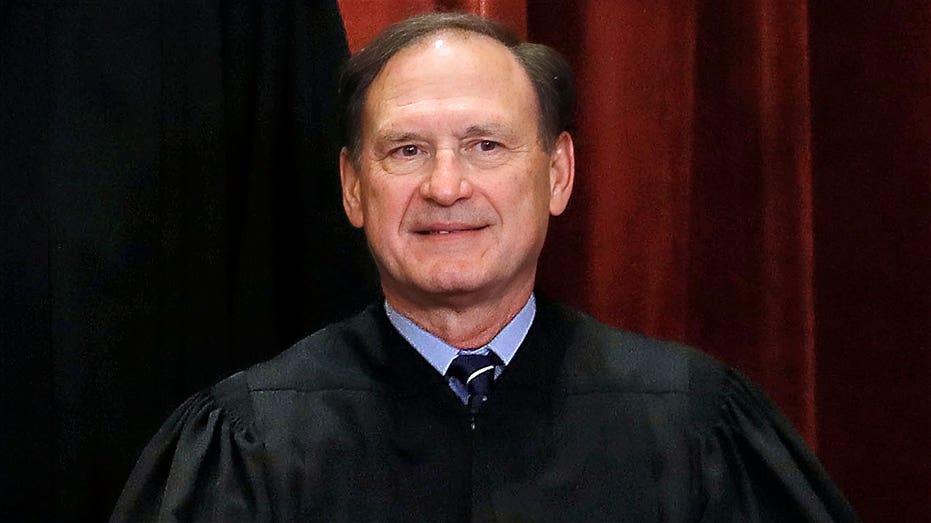
Supreme Court Justice Samuel Alito recused himself from a closely watched case over climate change liability less than a week before oral arguments were scheduled to begin.
Scott Harris, the clerk of the Supreme Court, informed the parties' lawyers in a letter Monday that Alito had recused himself from Suncor Energy Inc. v. County Commissioners of Boulder County without providing an explanation.
"Justice Alito does not take his duty to sit lightly. We do not know why he recused himself, as the reason has not been made public, but I do not expect his recusal to ultimately change the outcome of Suncor v. Boulder," Carrie Severino, president of JCN, told Fox News Digital.
LAWSUITS COST EVERY AMERICAN HOUSEHOLD THOUSANDS OF DOLLARS. SUPREME COURT CAN HELP
The justices were scheduled to kick off the 2026-27 term by hearing oral arguments in Suncor v. Boulder on Monday. The case centers on whether Boulder, Colorado, can use its state-law tort claims to sue oil and gas companies over their alleged role in contributing to climate change.
The case has drawn scrutiny from Republicans, who argue Colorado officials are weaponizing the court system to get their environmental agenda enacted.
"What they're doing is they're going around to these cities and these states, and using tort litigation, mass tort litigation, public nuisance lawsuits in state courts, and in a coordinated way to effectuate the same kind of a result, but just without having to go through their democratically elected officials," Steve Cox, former Alaska attorney general and current counsel to Alaska Gov. Mike Dunleavy , said in a Tuesday conference call.
"It's not a fight about climate change," O. H. Skinner, former Arizona solicitor general and executive director of the Alliance for Consumers, said during a Tuesday conference call. "It's not a fight about climate science."
"It's a fight about whether we're going to allow this maneuver to be what reshapes American society, and that's why I think everybody should care, irrespective of their views on climate change or their views on how to fix this problem or that problem. Do you want courts as our primary policymakers?"
Skinner acknowledged that Alito did not come to his decision lightly, but said its "never good for the court" when a justice is missing from a ruling.
CONSERVATIVE GROUPS SAY JUSTICE KAGAN CANNOT BE IMPARTIAL IN UPCOMING SUPREME COURT CLIMATE LITIGATION
"This is part of why the left constantly screaming at the justices about recusal and other things is counterproductive for the country," Skinner said. "It doesn't help the court when they don't have their full complement."
"At the same time, he made that decision knowing all of that and based on his own personal considerations, and we will never know all of the details of that. At the end of the day, it does not help the court to not have their full complement, but it is also not something that we think will be dispositive of the case, and it's not something that we think is noteworthy, other than that he made that decision based on his own considerations and didn't do it lightly, and he is making the right choice in his mind," Skinner continued.
Alito's last-minute decision to recuse himself from the high-stakes climate case follows his January recusal in Chevron USA Inc. v. Plaquemines Parish , a Louisiana coastal erosion dispute, because he owned stock in ConocoPhillips, the parent company of one of the parties in the related litigation, Burlington Resources Oil and Gas Company.
SUPREME COURT FINANCIAL DISCLOSURES REVEAL CONCERT TICKETS FROM BAD BUNNY'S LABEL, MILLIONS IN BOOK PAYMENTS
Meanwhile, Justice Elena Kagan has faced calls to recuse herself from Suncor v. Boulder because she wrote the foreword to the Reference Manual on Scientific Evidence, which included a climate science chapter that was later criticized by Congress and Republican attorneys general as biased and was eventually removed.
SIGN UP TO GET THE POLITICS NEWSLETTER
In July, more than a dozen legal groups, in a letter spearheaded by Severino, urged the Senate Judiciary Committee to open an investigation.
"Justice Kagan’s endorsement of the partisan and now-removed climate science chapter of the judges’ reference manual continues to raise questions about her ability to impartially decide the case. I hope she is taking her own ethical obligation seriously."