
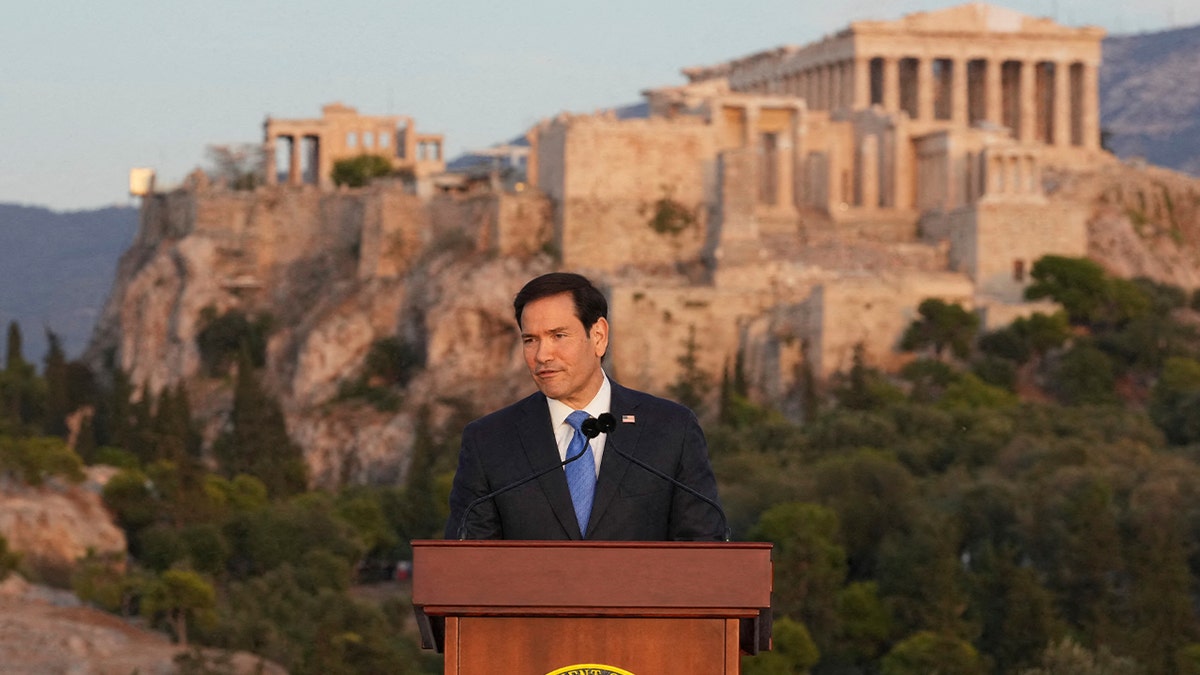
On Wednesday, I traveled to the Pnyx, a hillside overlooking the towering columns of the Acropolis in Athens. There, I delivered a simple message: The West is at a crossroads. The decisions we make in the next decade will define the next century – and determine whether our civilization maintains its place at the head of the world, or resigns itself to a future of servitude and decline.
For thousands of years, the Parthenon has stood as a testament to the Western spirit, captivating the imagination of our civilization’s artists, philosophers, and statesmen. The American Founding Fathers were fascinated by classical antiquity: The most commonly cited author in the Federalist Papers was Plutarch, the Greek biographer of Greece and Rome’s greatest men. The legacy of ancient Greece is carved into the architecture of our capital city itself, immediately visible in the famous columns and domes of Washington, D. C.
We all know the familiar history. Athens gave us democracy. Plato and Aristotle gave us Western philosophy. The Greek city-states shaped our ideas of citizenship, law and republican government.
RUBIO SOUNDS CAMPAIGN-READY AS HE RAILS AGAINST OPEN BORDERS, GLOBALISM IN SPEECH FROM ANCIENT GREEK RUINS
But our debt to Greece runs deeper than any particular political system or theory.
Ancient Greece was the birthplace of all the essential qualities that would come to define the West: fierce individuality and relentless ambition; restless curiosity, creativity, and invention; an insatiable desire for adventure, glory, and exploration, straining to test the limits of what man can know and do.
What the West inherited from classical Greece is not just the ambition to explore the unknown; it is the conviction that the unknown can be known.
The Greeks believed the world could be observed, measured, mapped and understood. That conviction became the foundation of Western science, medicine and philosophy. It prepared the fertile soil for Christianity to take root and flourish into European Christendom , and helped form a civilization with a distinctive understanding of truth, virtue, beauty, duty and the natural order – carrying a code that dictates how men ought to live, and objective standards and ideals to strive towards.
THE BEDROCK OF AMERICAN LIBERTY WAS LAID IN JERUSALEM
The ancient Greeks organized their civic life around the pursuit of those ideals. They believed men should strive and compete for excellence in athletics, war, art, philosophy, statecraft and every other field of human endeavor. The classical Greek city was an arena for great men to test and prove themselves through perpetual contest and struggle – to be the best, the strongest, the most beautiful, straining to surpass all those that came before.
WHY AMERICA’S NEXT 250 YEARS CAN BE GREATER THAN ITS FIRST 250
These are the qualities that shaped the West, pushing its descendants to create and achieve things that others could not – distinguishing us from the many cultures of the world where stability and subsistence were the highest ends of life.
But today, too much of the West has come to feel ashamed of the very things that made us exceptional. Over time, we began to view our achievements as an embarrassment; our power and prosperity became a source of guilt. So we opened our borders, outsourced our once-great industries, and allowed our militaries to wither and decay. And with every passing year, we transferred more of our sovereignty to global bureaucracies beyond our control.
WHY NATO’S DEFENSE SPENDING IMBALANCE LASTED FOR DECADES
Other nations were all too happy to fill the vacuum left by our weakness. They continued competing for territory, resources and influence, building up their own wealth and power in our stead.
Today, we find ourselves at an inflection point – not just in the United States, but across the whole of Western civilization.
TANVI RATNA: EUROPE SAYS TRUMP MADE AMERICA UNRELIABLE. THE TRUTH IS TOUGHER
Under President Donald Trump , the United States has chosen to take back control of our national destiny: rebuilding our defense, reindustrializing our economy , and fighting to dominate the technologies and industries that will define the future.
It is our sincere hope that the rest of the West will choose the same path.
There are encouraging signs across Europe. Defense spending is rising . Manufacturing and industrial capacity are returning to the center of political debate. European nations are beginning to recognize that sovereignty, borders, and military power are not relics of an irrelevant past, but prerequisites for a decent future.
AS AMERICA MARKS 250 YEARS, OUR GREATEST CHAPTERS ARE STILL AHEAD OF US
We do not believe the transatlantic friendship should be zero-sum. Quite the opposite: our vision is of an alliance whose strength is greater than the sum of its parts. We are many nations, but one civilization – born in Athens, forged in Rome, baptized in Christendom. Together, we must build an alliance capable of confronting the threats of our age.
CLICK HERE FOR MORE FOX NEWS OPINION
To do so, we must rediscover the spirit of the men who built the Parthenon , and rekindle the fire that was first lit in Athens millennia ago.
Ancient Greece does not just offer a glimpse of our institutions in their earliest form; it shows us an image of ourselves.
It shows us that ours is the inheritance of great heroes, and that we should be proud – fiercely proud – of where we came from. The story of our civilization is the greatest story ever known to man. But we must fight to defend it.
Together, the nations of the West can choose to reject decline, defend our shared heritage, and defeat the dangers of our time.
CLICK HERE FOR MORE ON SECRETARY OF STATE MARCO RUBIO