
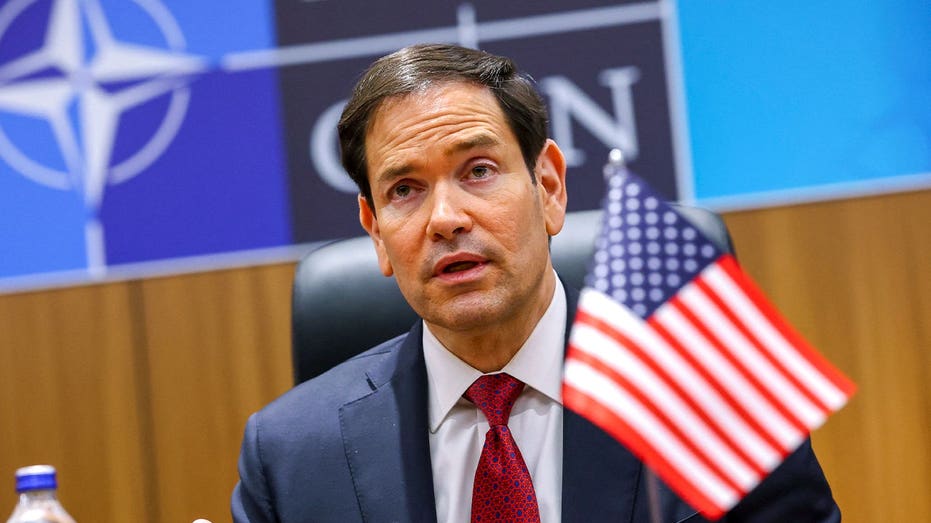
Secretary of State Marco Rubio questioned the "point" of NATO Tuesday after saying several allies blocked the U. S. from using military bases on their soil during the conflict with Iran.
"We had a couple countries say, ‘You can't use your base here.’ Well, that's absurd," Rubio said on "Fox & Friends."
"If we can't use our base when we have a contingency, what's the point of having the base and, frankly, the point of the alliance?"
TRUMP VOICES FRUSTRATION WITH NATO, SAYS IRANIAN NAVY ‘DESTROYED’ AS US PREPS FOR BLOCKADE
Rubio, who described himself as a longtime supporter of NATO , argued that access to bases across Europe has historically been one of the alliance's greatest strategic benefits for the U. S., allowing American forces to project power globally.
"I've been a strong supporter of NATO my entire career," he told co-hosts Ainsley Earhardt, Lawrence Jones and Brian Kilmeade.
PENTAGON SLASHES NATO COMBAT COMMITMENTS AS TRUMP PUSHES EUROPE TO DEFEND ITSELF
"But I understand that one of the arguments I used to use was that one of the biggest benefits NATO had to the United States were these bases in Europe that allowed us to project power into different parts of the world."
"If that's going to be denied to us, then we've lost the biggest reason for us to be in NATO . That's the point we've raised," he added.
Though the secretary did not identify which countries denied access in the interview, several NATO allies previously restricted U. S. military access during the Iran conflict. Italy, for instance, denied U. S. bombers landing rights at Naval Air Station Sigonella in Sicily, per a Newsweek report .
The same report indicated that Spain closed its airspace to U. S. planes involved in the conflict. France separately restricted some U. S. military flights carrying supplies to Israel.
Rubio acknowledged that some NATO countries had "done more" than others during the conflict, but did not specify which ones.
"I hope we've crossed a point where that [resistance from NATO countries] is no longer going to happen. I think we've had more cooperation lately from a number of countries in NATO, so that is positive, but we're still very disappointed."