
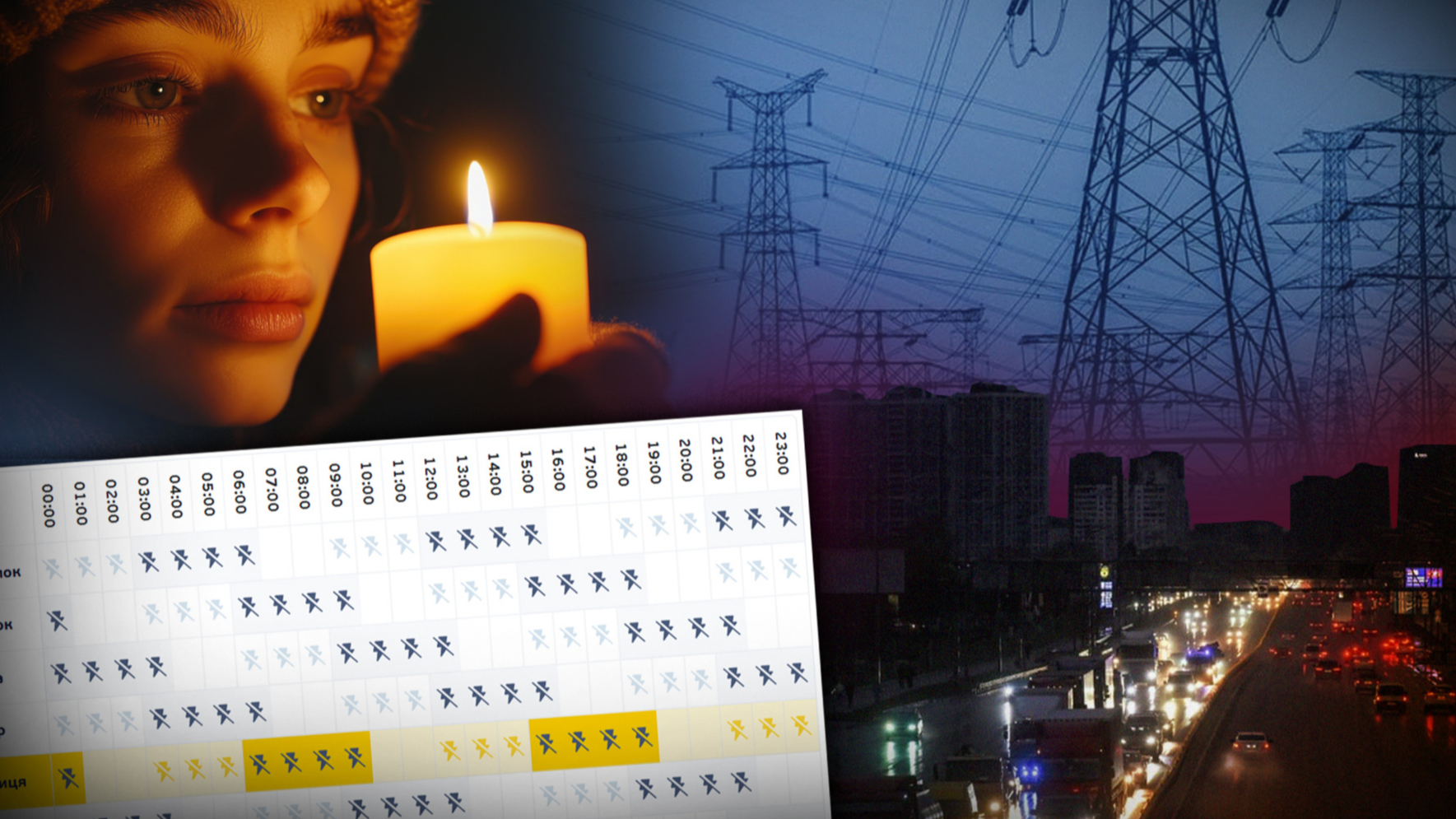
Hopes for a mild winter or inaccuracies in Russian strikes will not help Kyiv get through this winter without problems with its electricity supply. The only question is how long the power cuts will last and whether air defence forces and power engineers will manage to prevent the worst-case scenario.
The Russians are continuing their systematic attacks on Kyiv and Kyiv Oblast, seeking to completely destroy the city's combined heat and power plants and break the so-called power ring in order to plunge the capital entirely into darkness and cold.
The city has already lost a significant proportion of its own power generation capacity, while strikes are destroying substations through which electricity is supplied from other regions. In the event of severe frosts and further hits, a scenario involving 20 hours without electricity no longer seems far-fetched.
What is Kyiv's power ring, what risks does damage to it pose, and what should the capital's residents prepare for?What is Kyiv'spowerring? This article does not disclose any sensitive information. The configuration of the power system is no secret to Russia , as Ukrenergo, Ukraine's state-owned electricity transmission operator, has warned. What does remain secret are the protection systems, equipment redundancy arrangements and power restoration procedures following attacks. In the narrow technical sense, Kyiv's power ring is a system of high-voltage power lines and 330-kilovolt (kV) substations that connects the capital to Ukraine's integrated power grid and enables electricity to be transmitted to the city from different directions. A key element of the capital's power supply is the 750 kV Kyivska substation, through which electricity from the Rivne and Khmelnytskyi nuclear power plants can be delivered to the capital. Given their strategic importance, these facilities are under constant attack by Russian forces. The aim is to cut Kyiv off from Ukraine's integrated power grid and cause a blackout. Put simply, the ring is a kind of road network for electricity. Transmission lines carry electricity to the capital, while substations step down its voltage and feed it into distribution networks for consumers. If one section of this "road" is damaged by attacks, electricity flows can be rerouted through other lines. This helps maintain the power supply after damage occurs. The ring is a critically important element of Kyiv's energy supply because the city consumes far more electricity than its own sources generate.How much electricity does Kyiv consume, and why have power cuts begun? Kyiv is the largest consumer of electricity in Ukraine. According to estimates by energy experts, the city consumes 1-1. 2 GW, or 12-15% of the national total. In winter, depending on the temperature, demand can rise to 1. 8-2 GW. In 2025, before the large-scale winter attacks, local generation played a key role in supplying electricity to the city. According to sources at one of the energy companies who spoke to Ekonomichna Pravda, it may have accounted for as much as 1. 3 GW. This came primarily from Kyiv CHP-5, CHP-6 and Darnytsia CHP (CHP-4) – combined heat and power plants (CHP plants) that produce both electricity and heat for the city's district heating network . These plants are now no longer able to generate electricity. Nevertheless, all three CHPs were hit again by the Russians during the large-scale attack on the night of 13-14 October. Read more: Russia's winter campaign against energy infrastructure has begun. Will Kyiv be left without electricity, heating and water? The capital is now forced to rely more heavily on electricity supplied from other regions via the power ring. The problem is , however, that its key components have been under constant attack for more than a month. Some of these attacks result in damage to equipment. To cause significant problems, the Russians do not necessarily have to destroy the entire power ring. It is enough to damage a few critical nodes through which a large share of the electricity flows. As a result, a situation may arise where there is electricity in the system, but the grids cannot transmit it to the capital in the required volume. If the city lacks its own power generation, the situation becomes even more complicated. Under such conditions, dispatchers are forced to restrict consumption, including by introducing emergency or scheduled power cuts. This makes it possible to maintain a balance between available capacity and consumption and to prevent a large-scale failure in the power system. The time needed for repairs depends on the extent of the damage. Some equipment can be repaired quickly. Replacing a large power transformer or other complex equipment may take longer, especially if the necessary equipment is not held in reserve. Further complications are caused by repeat attacks, air-raid warnings being in effect for long periods , risks to repair crews and government attempts to reduce the proportion of energy company employees eligible for deferral from mobilisation. Following emergency repairs, the situation can deteriorate again, as strikes have been relentless lately and power workers face the risk of further attacks.What to expectthiswinter The main risk for Kyiv is a combination of three factors: low air temperatures, high consumption and Russian strikes that restrict the ability to transmit electricity to the capital. Given this combination, even fully functioning power generation in other regions does not guarantee that Kyiv will receive enough electricity, making various scenarios possible. In a relatively favourable scenario, energy workers will repair damaged equipment and new strikes will not cause critical losses. In that case, restrictions may be moderate, although avoiding power cuts altogether will be difficult. For consumers, this would mean8-10 hours without electricity per day . If the attacks continue and some equipment remains damaged, Kyiv could face longer power cuts during moderate ly cold spells. Under this scenario, outages could last12-16 hours per day . The worst-case scenario involves regular large-scale strikes on key substations and other elements of the power system amid severe frosts. In that case, restrictions could lastup to 20 hours per day . However , sources in the energy sector interviewed by Ekonomichna Pravda do not believe in a scenario in which the Russians would manage to destroy everything and "plunge Kyiv into darkness". The consequences will depend on which facilities are damaged, how quickly they can be repaired and how much electricity can be transmitted to the capital. A separate challenge is keeping critical infrastructure running , including water supply pumps, heating systems, transport, hospitals and communications. Read also: No electricity means no water: an interview with the deputy CEO of water utility Kyivvodokanal The capital needs approximately 200 MW of generating capacity for these purposes , primarily from combined heat and power units and high-capacity generators. According to Ekonomichna Pravda 's sources, 150 MW of distributed generation has been brought into operation in Kyiv. By the end of 2026, this is expected to increase to 180-185 MW. Private facilities accounting for another 55-60 MW could become operational before winter, around half of which are already ready. * * * It is clear that protecting energy facilities critical to Kyiv from ballistic missiles depends primarily on the effectiveness of air defence. The engineering protection built at most substations can reduce the impact of individual strikes, but it cannot guarantee the survival of critical equipment after a direct hit. Amid a shortage of missiles for Patriot systems, it is important to have the necessary amount of backup equipment, trained repair crews and clear action protocols for crisis situations. Experience from previous winters shows that energy workers have learned to work under conditions of large-scale destruction. However, this does not cancel out the physical limitations of the grid and does not guarantee an uninterrupted electricity supply under every attack scenario. Three things will be decisive for Kyiv this winter: how much electricity can be delivered to the city, how quickly energy workers can repair damaged equipment and whether backup generation can sustain critical facilities. How long the power cuts last will depend on this. Kyiv can get through the winter without a collapse of its power supply, but it would be naive to expect the capital to avoid prolonged power outages if constant attacks continue. By Mykola Topalov Translated by Anna Kybukevych and Solomiia Shvak Edited by Susan McDonald