
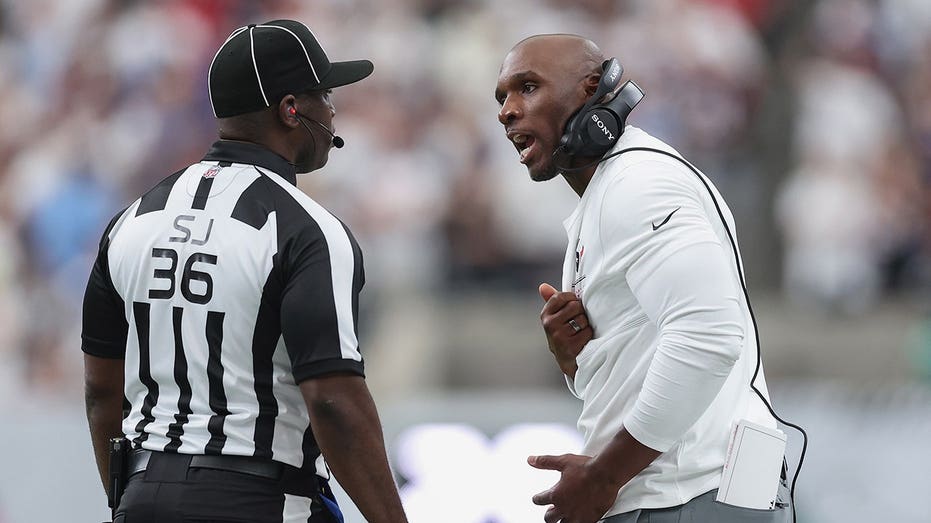
I've been writing about the NFL's officiating problem for years. At some point, I'd love to stop.
Apparently, that point isn't coming anytime soon.
Week 3 delivered another collection of calls that left fans wondering what, exactly, NFL officials were watching. We had a potential game-sealing interception erased by a phantom penalty, a receiver rewarded for interfering with a defender and another installment of "is that a fumble or an incomplete pass?"
Oh, and grabbing an opponent's facemask apparently became optional to penalize.
NFL WEEK 3 SUNDAY TAKEAWAYS: PATRIOTS HAVE A MAYE PROBLEM, CHARGERS HIT ROCK BOTTOM AND COWBOYS CRUMBLE
Some teams overcame the mistakes. Others didn't. But winning the game shouldn't be a requirement for complaining about obvious officiating failures.
Let's start with the one that helped decide Sunday night's game.
With Denver trailing 26-23 late in the fourth quarter, Bo Nix threw toward Pat Bryant on third-and-6 from the Rams' 11-yard line and Josh Wallace intercepted the pass. At that point, the game was over. The Rams would take possession, kneel down, and move to 2-1.
Instead, officials flagged Wallace for pass interference, erased the interception and handed Denver a fresh set of downs near the goal line. Nix scored the winning touchdown a few plays later, and the Broncos escaped with a 30-26 victory.
There was contact between Wallace and Bryant, but there's an argument that Bryant was the one pulling Wallace. Then, there was Bryant's obvious flail to try and draw the flag. Obviously, you can't fault Bryant: it worked. He even admitted it after the game.
"I sold it just a little bit," he said.
Yes, clearly.
Multiple NBC commentators, including rules analyst Terry McAulay, said it wasn't defensive pass interference.
Yes, the Rams blew a 16-point halftime lead and, yes, they had opportunities to put the game away earlier. None of that changes the fact that Wallace made the play Los Angeles needed, only to have it taken away.
The Denver penalty had the biggest consequence but a late pass interference call in Cowboys-Ravens might have been the worst actual call.
With Dallas trailing 31-28 in the final 30 seconds, Dak Prescott threw toward CeeDee Lamb near the end zone. Ravens cornerback Nate Wiggins was in position to make a play on the football. Lamb grabbed Wiggins' arm, preventing him from trying to intercept the pass to seal the game.
When the flag hit the field, CBS analyst J. J. Watt speculated the referees were going to call offensive pass interference.
Nope.
Officials flagged Wiggins for defensive pass interference with no call on Lamb.
These are calls that cannot be missed in an NFL game. For the referees to not only miss the obvious offensive pass interference that prevented a potential interception but penalize the defender is completely inexcusable.
Fortunately for Baltimore, the Cowboys failed to turn that gift into a touchdown. Dallas settled for a tying field goal before Lamar Jackson found Zay Flowers to set up Tyler Loop's winning 56-yard kick.
The Ravens won 34-31. Once again, though, that doesn't excuse the referees. Just because the ball didn't lie doesn't mean it should have been put in that position in the first place.
CLICK HERE FOR MORE OUTKICK SPORTS COVERAGE
Saints fans have a pretty reasonable question: Why does the definition of an incomplete pass seem to change depending on which team benefits?
In Week 1, Chase Young hit Jared Goff as the Lions quarterback attempted to throw. The play initially produced a Saints fumble return for a touchdown, but replay changed the ruling to an incomplete pass .
On Sunday, Tyler Shough lost the ball while attempting a pass against the Raiders. This time, the fumble ruling stood after review. The plays looked eerily similar but produced the opposite result.
Las Vegas recovered and scored the go-ahead touchdown six plays later, eventually winning 35-27.
NFL replay official Mark Butterworth said Shough's hand wasn't moving forward with control of the ball. I agree, for the record. Shough absolutely fumbled that football and the Raiders earned a turnover. But so did Goff and so did the Saints in Week 1.
Missing calls is one thing. But changing the interpretation of the rulebook seemingly on a weekly basis creates a consistency problem that can't, and shouldn't, be ignored.
Before Josh Allen threw his second interception, a Chargers defender was literally standing in the neutral zone. His helmet was practically touching the helmet of an offensive lineman. Allen appeared to assume he had a free play and heaved a deep shot downfield into double coverage.
The Chargers defender made an insane interception on the throw. The problem is that it shouldn't have counted.
Believe it or not, this wasn't even the only questionable offsides call in the game. In the possession immediately following that Allen interception, Bills defender Bradley Chubb made a veteran play to time his rush with the play clock. The broadcast play clock hit zero and stayed there before Chubb headed toward Justin Herbert. Instead of calling delay of game, referees flagged Chubb for offsides.
The Chargers declined the penalty because Herbert completed a 13-yard pass on third-and-12, but the play shouldn't have happened and the Chargers should have had third-and-17.
Buffalo ultimately won 24-16, despite the bad calls. I'm tired of repeating myself, but the outcome of the game doesn't absolve referees from not doing their jobs correctly.
Tampa Bay deserves particular attention here because the Buccaneers had at least two apparent facemask penalties go uncalled in a 23-16 loss to Minnesota.
On one, Kenneth Gainwell's facemask was grabbed during a run, with Baker Mayfield immediately protesting the lack of a flag. On another, Mayfield himself had his facemask pulled.
To be clear, the Bucs have more problems than just poor officiating. But when a game ends with a seven-point margin, missing multiple opportunities to award 15 yards and a first down matters.
And Tampa Bay wasn't alone.
Deshaun Watson had his facemask grabbed during a sack against Carolina with no call. In Miami, there was a missed facemask call on De'Von Achane and an unpenalized tackle on Malik Willis where a Kansas City defender literally ripped the helmet off the Miami quarterback's head.
Meanwhile, the Chiefs-Dolphins game also featured a questionable roughing-the-passer call on Chop Robinson for his hit on Patrick Mahomes. As OutKick's Armando Salguero noted, another Miami penalty would have extended that possession anyway.
Still, it's fair to ask how officials can scrutinize the way a defender lands on a quarterback while missing another defender ripping the helmet off the other quarterback's head.
I've written this many times before, and apparently I'll keep writing it: the NFL has an officiating problem .
No, I don't think that means the games are scripted.
I think it means too many obvious mistakes are affecting games, and fans, coaches and players are rightfully tired of it.