
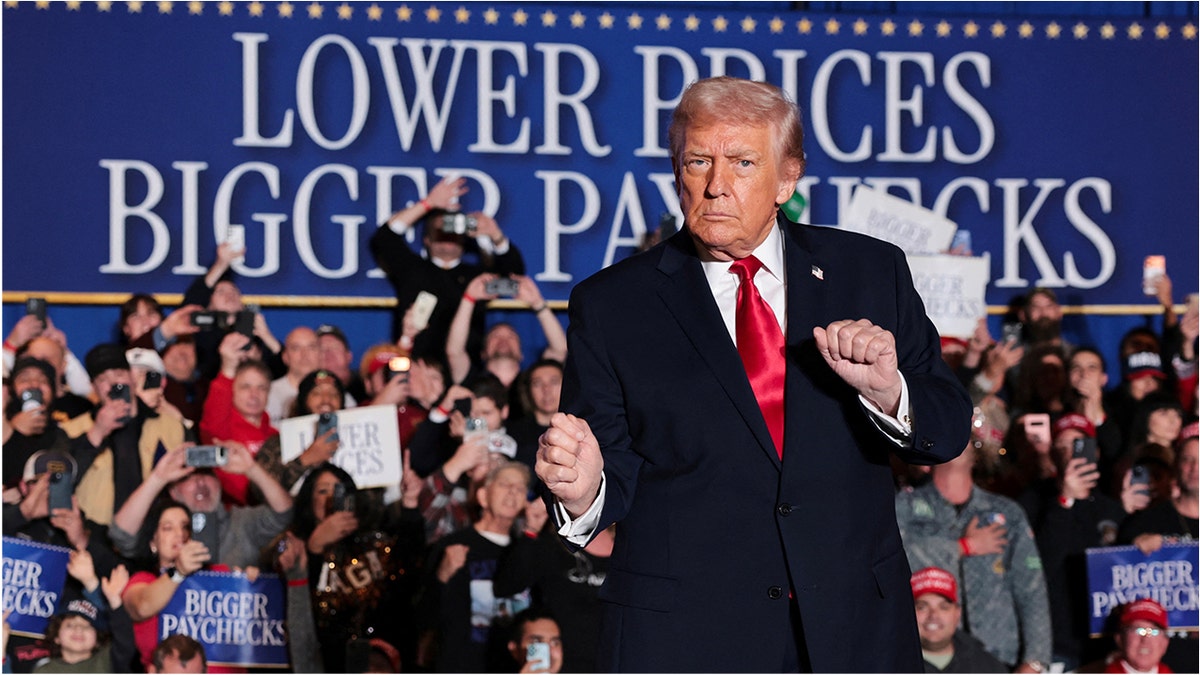
Roughly three-quarters of voters have rated economic conditions negatively for the past year, and more than three times as many say they are falling behind financially as getting ahead, according to a Fox News survey released Wednesday. And by a wide margin, the Democrats are considered the party that would better handle inflation — at a time when the cost of living and the economy are voters’ top concerns.
FOX NEWS POLL: COOL YOUR SERVERS! VOTERS REJECT DATA CENTERS
Costs of everyday items are a hardship for voters: 61% say gas prices are a major problem, up from 48% two years ago, while 52% say the same for healthcare costs, up from 44%. Majorities also view housing costs (54%, down from 60%) and grocery prices (62%, down from 66%) as major problems.
FOX NEWS POLL: VOTERS OPPOSE THE IRAN WAR, SEE PROLONGED COMMITMENT
Views on tariffs have grown more negative since last summer, with a high of 64% saying tariffs hurt the U. S. economy, up from 57%. Most Democrats and independents say tariffs hurt, while views among Republicans are mixed (41% help, 36% hurt, 21% no difference).
Overall, nearly two-thirds of voters (63%) say the Trump administration has made the economy worse, including a quarter of Republicans.
All of this contributes to greater pessimism about the future. The portion saying life will be worse for the next generation has risen from 53% two years ago to 62% last year and 68% today, just two points below the high of 70% in 2022.
Only 8% are enthusiastic about how the government is working, with another 23% satisfied. A 68% majority is unhappy, including a high of 33% who are "angry" — driven by 56% of Democrats and 36% of independents vs. just 9% of Republicans.
Despite these economic headwinds and with 48 days until Election Day, maybe the good news for the Republicans is that the Democrats' advantage on the congressional ballot has stayed in the single digits. If the election were today, 51% say they would back the Democratic candidate in their House district and 44% the Republican. The Democrats’ 7-point edge is just outside the survey’s margin of sampling error. Since January, the Democrats have been preferred by 5-7 points.
Women, those under age 35, Hispanic voters, and Whites with a college degree give Democrats their edge, while White men and non-college Whites are strengths for the GOP.
Party loyalty slightly favors the Democrats, as more of them (97%) than Republicans (92%) support their party’s candidate. Independents favor the Democratic candidate 53-31%, with 14% undecided.
Higher engagement boosts Democrats: 64% are extremely interested in the election compared to 53% of Republicans (+11 D margin). And more Democrats (71%) than Republicans (65%) rate their likelihood of voting as a 10 on a 10-point scale, meaning they feel certain they will vote (+6 D margin).
Among those certain to vote (10 s), the Democrats’ lead in the generic ballot grows to 11 points (54-43%).
The edge holds among those in "close" counties, where the 2024 presidential vote between President Trump and former Vice President Harris was within 10 points; the Democratic candidate is favored by 9 points, 52-43%.
"When pundits and analysts talk about the fundamentals favoring the Democrats in this midterm, they are mostly referring to the economy," says Republican pollster Daron Shaw, who conducts the Fox News Poll with Democratic pollster Chris Anderson. "Time is running out for the administration and its supporters to convince voters that things are improving."
Those with a negative view of both the Democratic and the Republican Party ("double haters") favor the Democratic candidate in their district by a 26-point margin.
Voters trust Democrats on most issues in the survey: inflation (by 15 points), large AI data centers (+14), corruption (+11), and foreign policy (+10). The parties are about evenly rated on immigration (R +1).
Prior to this summer, the Republicans held a four-year advantage on immigration, and they led on foreign policy until January of this year. Four years ago, Republicans were preferred by 9 points on inflation.
Democrats have improved their ratings on inflation by 5 points just since July.
Voters trusting Democrats on inflation are more likely to attribute this to Republican failures (51%) than confidence that Democratic policies are likely to reduce prices (47%).
Those views contribute to Trump’s 39% job approval (61% disapprove). His approval has not exceeded 39% since April, when it stood at 42%. His current rating trails former President Biden’s 43% at this point in 2022 and aligns with former President Obama’s 38% before the 2014 midterms. Trump received 43% approval on immigration, 37% on foreign policy (one point above his record low), and 24% on inflation (matching a previous low).
Trump’s standing puts him in a difficult spot to help GOP candidates this year. He lags his party in popularity, holding a 24-point net negative favorability rating (38-62%), unchanged since July.
Sixty percent of voters think the U. S. made the wrong decision in taking military action against Iran, and 77% of that group favor the Democratic candidate in their district.
Four years ago, more voters said a Trump endorsement made them less likely to support a candidate by a 15-point margin. Today, that’s a 26-point gap (25% more likely, 51% less likely).
Still, Trump’s approval matters within the GOP: 52% of Republicans and 75% of MAGA Republicans say it increases their support.
In addition, 53% say the Trump administration is more corrupt than previous administrations compared to 26% who say it is less corrupt.
Both major parties are viewed negatively: the Democratic Party is underwater by 11 points (44% favorable, 55% unfavorable) and the Republican Party by 17 (41-58%).
Nearly two-thirds support raising taxes on the wealthy to expand government programs (65%) and redistribute wealth (63%). However, 52% disagree with increasing taxes on the wealthy so that "nobody gets too rich."
Still, dissatisfaction with capitalism has grown. Fifty-seven percent say the way capitalism works in the U. S. these days doesn’t give people a fair shot, up from 42% in 2019. That shift spans political views, increasing among Democrats (by 17 points), Republicans (+13), and independents (+22).
Poll-pourri
When asked what the most important issue is facing the country unprompted by a list, 34% of voters say the cost of living and 14% say the economy/jobs. The next closest are immigration (8%) and Republicans/Trump/MAGA (7%). Only a handful mention issues like the war with Iran (4%), corruption (4%), healthcare (4%), or AI/data centers (1%).
MAGA holds a 5-point favorability edge compared with the Democratic Socialists of America (35% vs. 30%), although 15% are unable to rate the DSA. Nearly 3 in 10 Democrats view the DSA negatively, and 3 in 10 Republicans view MAGA negatively.
Overall, 59% view labor unions favorably, including 48% of Republicans and 73% of Democrats.
Eighty-one percent of voters favor banning Congress members and their immediate family and staff from trading stocks (up from 75% in January), including 8 in 10 Democrats, Republicans, and independents.
CLICK HERE FORCROSSTABSANDTOPLINE Conducted September 11-14, 2026, under the direction of Beacon Research (D) and Shaw & Company Research (R), this Fox News survey includes interviews with a sample of 1, 211 registered voters randomly selected from a national voter file. Respondents spoke with live interviewers on landlines (96) and cellphones (821) or completed the survey online after receiving a text (294). Results based on the full sample have a margin of sampling error of ±3 percentage points. Sampling error for results among subgroups is higher. In addition to sampling error, question wording and order can influence results. Weights are generally applied to age, race, education, and area variables to ensure the demographics are representative of the registered voter population. Sources for developing weight targets include the most recent American Community Survey, Fox News Voter Analysis, and voter file data. Fox News’ Victoria Balara contributed to this report.