
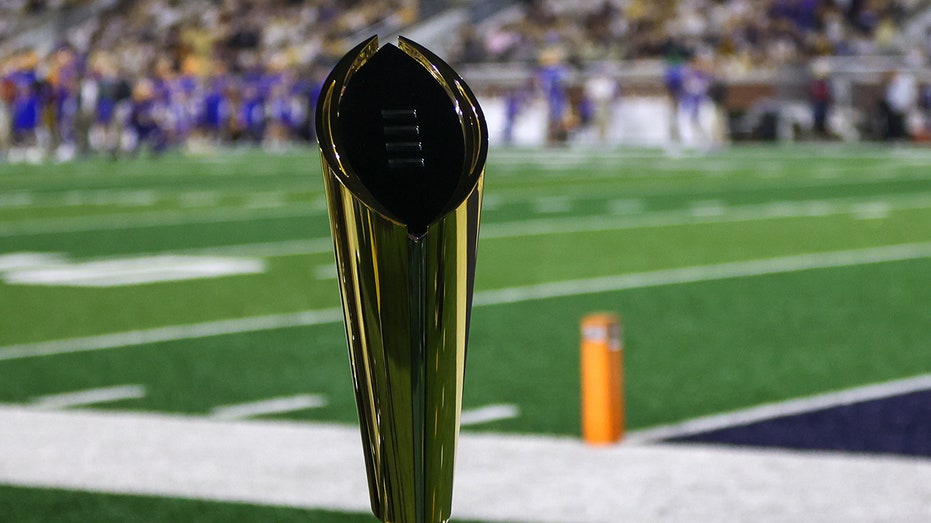
For a sport that spent decades with effectively the same system, structure and configuration, the rate of change in modern college football is jaw-dropping.
The first iteration of the College Football Playoff was in 2014, not too long ago, in the grand scheme of things. Four teams, picked by a selection committee, played two rounds to win a title. For a decade, despite a long list of controversial choices by that committee, it stayed at four teams. Then, the expansion.
After a wave of criticism from Florida State's exclusion from the 2023 edition and administrators realizing that there was a massive reservoir of revenue available if the sport added playoff games, the sport moved to 12. Just a few years later, here we are and most of the major players involved seem set to blow tradition up further and move to a whopping 24 teams. Seriously.
SIGN UP FOR THE DAILY OUTKICK NEWSLETTER
The execs who control the playoff format met this week outside Chicago, with several new reports saying that the 24-team playoff is all but a done deal.
"We've worked through a lot of the other issues associated with [a 24-team] expansion and those things needed to happen before we started any kind of negotiation [over money]," said executive director Rich Clark, per Yahoo!'s Ross Dellenger .
There's a widespread assumption that the money will be there to make an expansion possible, whether that's with the current network, ESPN or another broadcast partner. And Clark seemed confident enough to publicly explain some details of how the new format would work.
Eight first-round games would start two weeks after the end of the regular season, essentially one week after the current conference championship game window. This would eliminate conference championships, long viewed as a necessary consequence of further expansion. Second-round games, another eight, would follow in late December, "most likely" played at the home stadium of the lower seeded team. Similar to the current first-round format.
Dellenger also quoted a "confident stakeholder," who is adamant that if the money materializes through a TV deal, "we are definitely going to 24."
CLICK HERE FOR MORE OUTKICK SPORTS COVERAGE
There are two ways to react to this news, but a few things seem certain about a 24-team field: traditional bowl games are all but dead, with reaching a 24-team field all that matters. The other? That the college football regular season, long the best in sports, will be irreparably changed.
There’s no question that three-loss teams will be part of a 24-team playoff. It’s a near certainty that four-loss teams will be too. Those close losses between rivals or top programs that were once so meaningful will now just be another week in the schedule, particularly in the era of superconferences, where strength of schedule will guarantee spots for some three-loss teams and four-loss teams.
There is another possibility, as unlikely as it is, that big teams are more willing to schedule each other in non-conference weeks, given that losses are less harmful on an overall resume.
THE CRAIG CARTON SHOW–UNFILTERED, UNAPOLOGETIC AND UNMISSABLE. DOWNLOAD HIS DAILY PODCAST NOW!
For example, when the Texas Longhorns lost to Ohio State in 2025 and missed the playoff, head coach Steve Sarkisian went ballistic. He called it a "disservice" to the sport, and ranted about the importance of schedules while threatening to reevaluate future matchups to give the Longhorns an easier path to the tournament. Obviously, he had a different tune after winning in 2026 , but the underlying point he made still stands. Easier schedules means a greater likelihood of a 10-2 season and a playoff berth.
But if three losses isn't a death sentence, are programs more likely to risk it with higher-profile matchups?
Particularly with ratings on the decline thus far in 2026, as well as even traditional powerhouses like Penn State struggling to sell out their stadiums, teams could sell season ticket packages on the promise of seeing big games. Even if losing doesn't carry the same penalty as it used to.
Texas didn't struggle to fill up their stadium for the Ohio State game. USC had ~50, 000 fans at the San Jose State game in miserable weather at 12 p. m., but sold out against Oregon. With ever-increasing competition for entertainment dollars, rapidly growing ticket prices, and the ease of following and watching games on smartphones, the best way to keep fans in the building is giving them a reason to come in the first place.
That said, even in a sport now infamous for quick cash grabs, this feels like the most blatant of them all. Conference championships and the bragging rights they bring are done. Revenue matters most, rather than competition or truly rewarding exceptional teams. Few fans, if any, have demanded or even wanted a 24-team playoff. But what fans prefer was already at the bottom of the list in terms of importance, and somehow it's sinking even lower.
Get ready for 8-4 Missouri playing 8-4 Wisconsin in the first round of the playoff, coming soon to a television near you.